Bottom-up AI governance for work that changes faster than policy can map.

AI adoption does not move through org charts. It spreads through prompts, spreadsheets, shared folders, inboxes, shortcuts and deadline pressure.

Industrial Linguistics builds simulations and lightweight work probes that show how AI is actually changing work before policies, registers and governance committees catch up.

We find the AI-shaped work your governance register cannot see.

AI Work Radar

AI Work Radar finds the work your AI policy cannot see. We use simulations, bottom-up prompts, shared-work artefacts and debrief evidence to surface shadow AI, spreadsheet systems of record, AI-visible knowledge, unclear ownership and governance gaps.

What is AI already seeing?

Shared drives, spreadsheets, inboxes, transcripts and unofficial knowledge bases are becoming the raw material for assistants, copilots and agents.

  • AI-visible knowledge maps
  • Shared-work artefact review
  • Connector and permission questions
  • Evidence for governance conversations

Where is AI already acting?

Staff use agents, copilots, summaries, coding tools and private workflows in ways no central register can fully capture.

  • Friday 4PM shadow-AI sessions
  • Now field prompts during real work
  • Anonymous idea-card clustering
  • Pilot and capability design

What breaks when bots misunderstand?

Ambiguous emails, stale files, hidden spreadsheet logic and missing context become operational risk when machines start reading and replying.

  • Bot-readable communication checks
  • Spreadsheet system-of-record probes
  • Governance room debriefs
  • Practical next-step maps

Simulation rooms

The useful AI conversation starts when people experience the system from the inside. Each simulation creates a small, playable version of a real organisational pressure: deadline shortcuts, hidden AI use, bot-readable communication, unclear ownership, incomplete telemetry or workforce shock.

Shadow AI / governance

Friday 4PM: shadow AI under deadline pressure

A 90-day office-pressure simulation where official tools, peer shortcuts, outsourcing, partial telemetry and AI governance collide. Participants feel why safe paths must be usable, not merely approved.

Use for

  • AI policy and governance workshops
  • Disclosure culture, vendor and shortcut-risk conversations
  • Leadership sessions about making the safe path usable
Bottom-up AI discovery

Now: bottom-up AI opportunity discovery

Random calendar or SMS prompts interrupt real work and ask: “Could AI help with what you are doing now?” The captures become anonymous evidence for clustering, pilot design and governance conversations.

Use for

  • Finding real AI use cases
  • Moving beyond generic AI brainstorms
  • Turning captured moments into workshop material
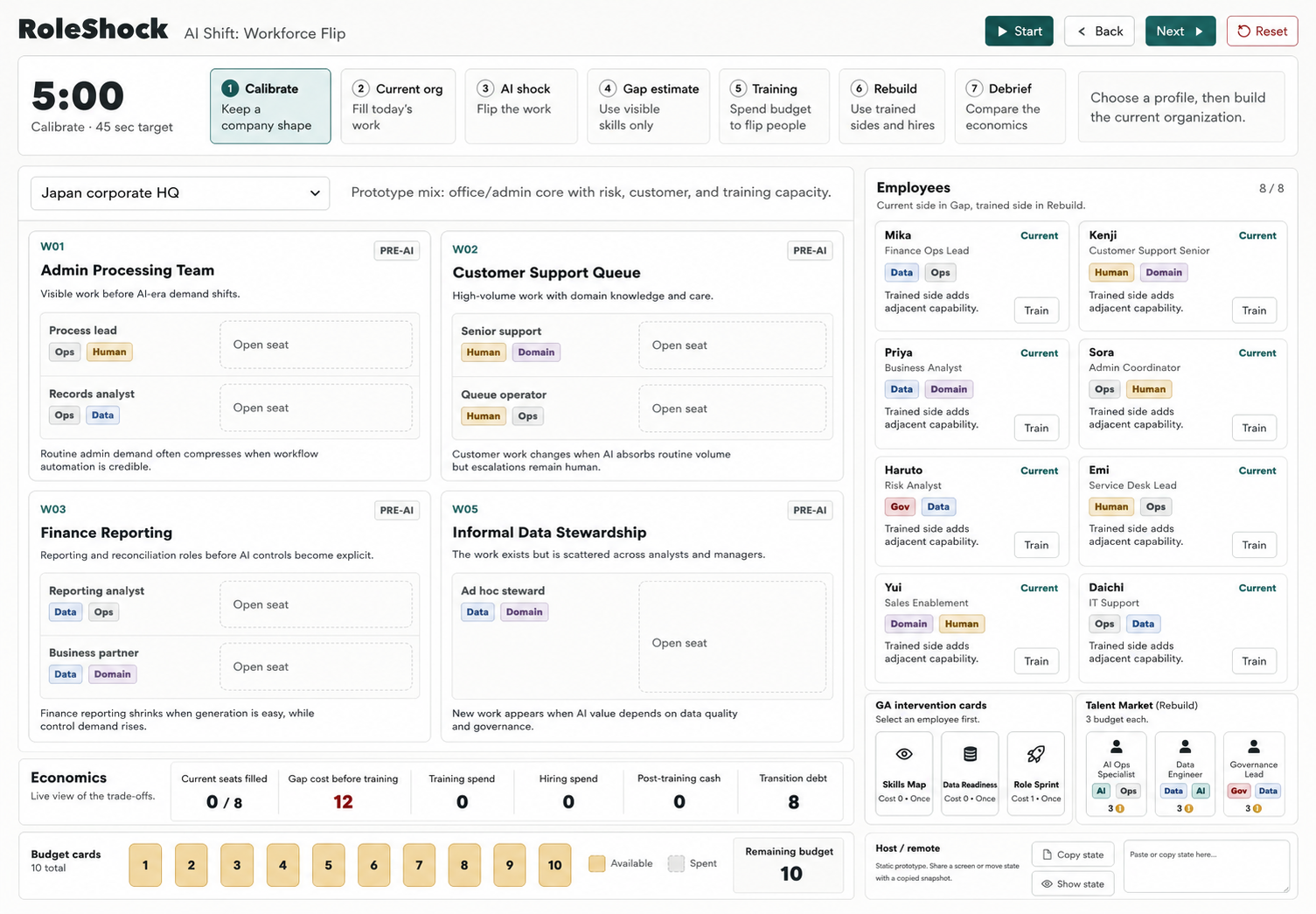
RoleShock simulation screen showing a workforce planning game board
Sales / workforce planning

RoleShock: workforce flip

A short simulation where teams try to meet new demand with today’s visible skills, then confront transition debt, cash burn and retraining tradeoffs.

Use for

  • AI workforce planning conversations
  • Sales meetings where the buyer needs to feel the operational gap
  • Workshops on reskilling and workforce transition

How the work becomes governable

Start with a short simulation or probe. Leave with a map of the work your AI policy cannot see and concrete decisions people can discuss.

Find the pressure

We define the deadline, shortcut, shared artefact, missing context or governance gap that makes AI-mediated work hard to see from the top down.

Build the probe or room

The first version may be a simulation, prompt programme, browser screen, card deck, spreadsheet, script or mix of artefacts. The point is to make the work visible quickly.

Run and collect evidence

Participants make ordinary choices under time, role, information and tooling constraints. The debrief captures what they notice, where they get stuck and what they trade off.

Turn evidence into decisions

The replay becomes pilot design, policy discussion, capability planning, governance register input or a practical next step.

Typical formats

The same core design method can produce a short sales-room exercise, a field prompt programme, or a longer tabletop session.

Five-minute sales game

Make the problem felt

For sales teams that need prospects to feel a problem before hearing the pitch.

Workshop simulation

Practise the decision

For 60-120 minute sessions where teams need to practise a decision, policy or change.

Executive tabletop

Work through uncertainty

For boards and leadership teams dealing with uncertainty, risk, AI governance or investment choices.

Two-week field exercise

Collect real examples

For AI adoption or discovery programmes where useful examples need to come from real work, not a brainstorm.

For consultants

If you already run advisory, transformation or training work, Industrial Linguistics can help you add a simulation layer to it. That might mean adapting one of the existing games, designing a game around your method, or leaving you with facilitator notes and materials your team can run without me in the room.

Talk about consultant use

Work-radar labs

Behind the simulations are practical instruments for seeing AI-mediated work: shared-folder mapping, spreadsheet system-of-record detection, bot-readable communication checks and local-first AI-use reflection. These are labs, prototypes and field experiments, not surveillance products.

AI-visible work

Worker-visible instruments that help people see which shared files, folders, spreadsheets and messages are visible to assistants, copilots and agents.

Shadow systems

Experiments for finding where spreadsheets have quietly become operational databases, where data is copied by hand, and where unofficial workflows carry real business risk.

Synthetic stakeholders

Brand monitoring and persona panels can become market signals, stakeholder reactions, synthetic customers and debrief evidence for simulation rooms.

Selected clients

Industrial Linguistics has worked with banks, technology companies, government, education, retail, professional services and high-change operating environments.

The client wall remains deliberately broad: the work has ranged from large institutions to specialist technology teams, government groups and smaller firms.

AAT
Akkodis
Allianz
ASB
Atlassian
Aon
ASG
Astron Technology
AstraZeneca
Bloomberg
Bank of Queensland
Breville
Bunnings
Busways
Carted
Commonwealth Bank
Kingston
Clayton Utz
COI
ControlAbility
Cranbrook
CSC
Data#3
DHM
Eclipse AI
Endeavour
Fandom
FastPass
Front
Fujitsu
General Assembly
GIC
HP
HSBC
ING
Iocane
JDS
HP Australia
K2
MCS
MLA
Melbourne Water
Morgan Stanley
Mori
Mutinex
Macquarie University
Neura
Novartis
NSC
NTT DATA
NSW Telco
Nuix
New Zealand Ministry of Social Development
Optiver
Optus
Parliament of Australia
PeopleReign
Perilya
Pixc
PCS
Royal Children's Hospital
SDI
Servicely
Signature
SunRice
Telstra International
Telikom PNG
Terem
Universiti Teknologi MARA
Unbox
UnitingCare
Vanuatu Treasury
Vodafone
WebPunch
World Vision
Woolworths
YOTS

Start with the work your policy cannot see.

The simplest first project is a short AI Work Radar session: a simulation or probe that reveals bottom-up AI use, hidden work systems and practical governance decisions.

Run AI Work Radar